The Cabinet Office says it saved 750 million pounds maintaining government buildings and sold two billion pounds worth. Its own watchdog says the repair bill behind both figures is at least 49 billion pounds.
Estimated reading time: 6 minutes
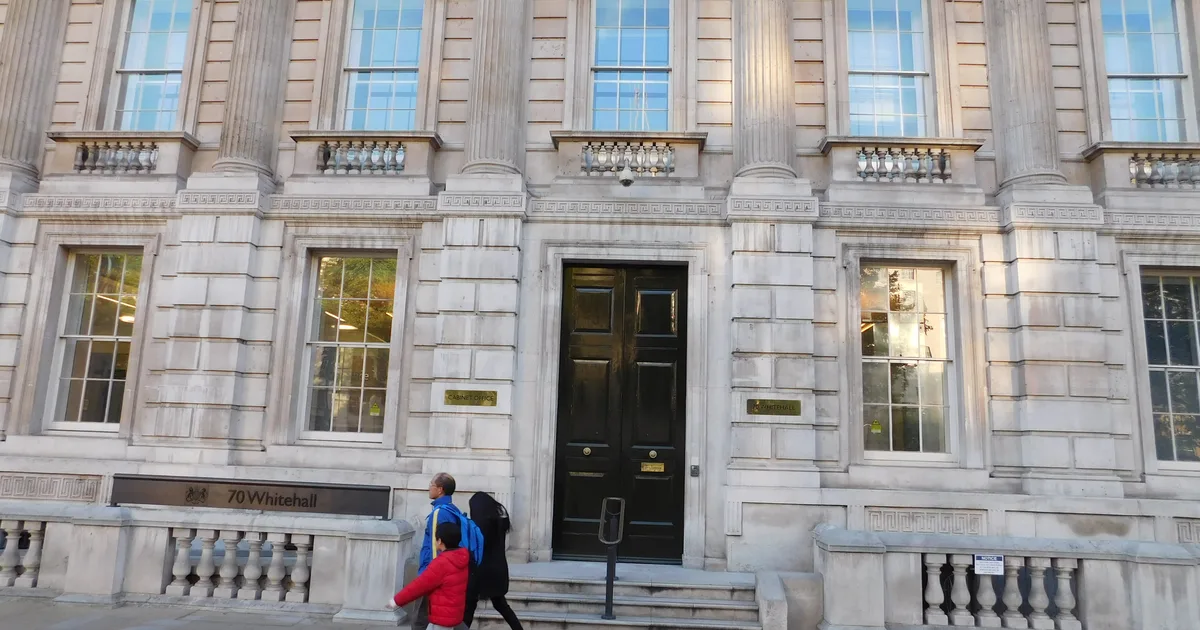

In short. The Cabinet Office's State of the Estate 2024-25 report, most recently updated 18 November 2026, headlines 750.1 million pounds of property running-cost savings and 2.0 billion pounds of disposal receipts over three years, on an estate now valued at 208.4 billion pounds [1]. Its own Head of Function Foreword names the National Audit Office's 2025 review of government property as "a significant moment of challenge and reflection" and discusses the maintenance backlog it uncovered twice, in general terms, without once stating the figure [1]. That review put the government's maintenance backlog at "at least 49 billion pounds", concentrated 88% in defence, schools and NHS property, and recommended the Cabinet Office start disclosing it from 2026-27 (para 1.13, p.22; para 1.14, p.22; Recommendation a, p.14) [2]. Two documented mistakes: four stars.
The 2024-25 edition of the Cabinet Office's annual State of the Estate report, first published 5 May 2026 and updated again on 18 November 2026, opens by calling itself a document of "pivotal" timing, written for "a direct call to action for the Government Property Function" [1]. Mark Chivers, the Government Chief Property Officer, signs its Head of Function Foreword with an unusually direct admission: "That means confronting some hard truths as well as celebrating real achievements. The National Audit Office's review of government property management was a significant moment of challenge and reflection" [1].
What the foreword does not do, having raised the review by name, is say what it found.
The numbers the report does state
The report is precise about its own achievements. The central government estate's reported freehold value rose 9.1% to 208.4 billion pounds; annual running costs fell 0.9% to 26.6 billion pounds [1]. Property running-cost efficiency savings reached 449.5 million pounds in 2024-25 alone, on top of 194.8 million in 2023-24 and 105.8 million in 2022-23, for a stated three-year total of "750.1 million pounds of property running cost efficiency savings", beating the government's own 500 million pound target a year early [1]. Disposals tell a similar story: "320 disposals from nine departments" in 2024-25 generated 367.3 million pounds, taking the three-year disposal total to "2.0 billion pounds" [1]. The foreword adds the Defence Infrastructure Organisation's 6 billion pound Annington Homes buyback and a 42.1% cut in estate greenhouse gas emissions to the same list of achievements [1].
Every one of those figures is dated, sourced to a named table or chapter, and checkable. None of them is the number the foreword's own "hard truths" sentence was about.
The number it does not
The National Audit Office's January 2025 report, "Maintaining public service facilities", calculated that "the maintenance backlog across government was at least 49 billion pounds as of October 2024" (para 1.13, p.22), "based on information provided by the 17 main government departments" [2]. That figure is not evenly spread: "MoD properties, schools and NHS properties have a backlog totalling more than 10 billion pounds each and make up 88% of the total backlog" (para 1.14, p.22) [2]. The NAO also warned that deferring it makes it worse: "The Cabinet Office has estimated that deferring backlog maintenance can multiply costs by over 1.5 times over a two- to four-year period" (para 1.12, p.22) [2]. Its summary conclusion was blunt: "The government has accumulated at least 49 billion pounds of maintenance backlog" against an estate whose "condition... has declined over the last decade" (para 20, p.13) [2].
The State of the Estate report's own Chapter 1 gestures at the same problem without naming it: "Condition of the built estate remains a critical issue. While data coverage has improved, condition and maintenance backlog are not evenly distributed across the estate. Risk is concentrated within large, operationally constrained portfolios, particularly prisons, health and schools" [1]. That sentence names the same three portfolios the NAO found carry 88% of a 49 billion pound bill, and then stops short of the number. The 750.1 million pounds the report spends three chapters celebrating as savings is 1.5% of it.
A disclosure already promised, not yet made
The NAO's first recommendation told the Office of Government Property to "include data on the maintenance backlog in the State of the Estate reports from 2026-27 onward" (Recommendation a, p.14) [2]. The 2024-25 report confirms it is working toward exactly that, "consistent with commitments made to the Public Accounts Committee", promising "more comparable reporting on estate condition within State of the Estate from 2026-27 onwards" [1]. On the department's own timetable, that is next year's report. This one, covering the year to March 2025 and still being updated as recently as five days before this piece, was never going to carry the figure, and does not say so plainly: a reader who does not already know the NAO recommendation exists has no way to tell, from this document alone, that the number has been deliberately deferred rather than simply omitted.
The NAO had already flagged why the gap matters: "The Cabinet Office does not regularly publish this information as it is incomplete. The Cabinet Office received condition data for only 64% of buildings falling within scope of State of the Estate reporting in 2022-23, and is concerned that the remainder are the buildings in the poorest condition" (para 2.7, p.26) [2]. The 2024-25 report's answer to that specific finding is a single unquantified line: "data coverage has continued to improve" [1]. No percentage is given, so the 64% figure the NAO used to justify its own "concerned" caveat cannot be checked against this report at all.
The claims, tested
| What the report says | What the record shows | Verdict |
|---|---|---|
| "The National Audit Office's review of government property management was a significant moment of challenge and reflection" [1] | The review calculated the backlog at "at least 49 billion pounds" (para 1.13, p.22) [2], a figure never stated anywhere in the document that names the review | The reflection is real. The figure it reflects on is not disclosed. |
| 750.1 million pounds of savings and 2.0 billion pounds of disposals are presented as the year's headline achievements [1] | The same estate carries a maintenance backlog of at least 49 billion pounds (para 1.13, p.22) [2], which deferral multiplies "by over 1.5 times" over two to four years (para 1.12, p.22) [2] | The savings are real and roughly 1.5% of the backlog they are not compared against. |
| "Data coverage has continued to improve" [1] | The NAO found condition data covered only 64% of in-scope buildings in 2022-23 and suspected the rest were the worst (para 2.7, p.26) [2] | An improvement claim with no baseline and no current figure cannot be checked against the one the NAO gave. |
Credit where due
The Head of Function Foreword is more candid than it had to be: it names the National Audit Office's review directly, in public, rather than leaving the comparison for others to draw, and admits in its own words that "maintenance has too often been treated as a short-term pressure to defer rather than a long-term investment to plan for" [1]. The savings and disposal figures are specific, dated and table-referenced rather than rounded into vagueness, and the commitment to disclose backlog data from 2026-27 matches the NAO's own recommendation to the letter [1] [2]. Naming a watchdog's criticism and then promising to meet it on the watchdog's own timetable is better practice than the silence that would have been easier.
The mistakes, counted
A watchdog review discussed, its finding withheld (1). The report's foreword calls the National Audit Office's review of government property "a significant moment of challenge and reflection" and twice describes the maintenance backlog it found in general terms, but never once states the figure: at least 49 billion pounds, 88% of it in defence, schools and NHS property, growing more expensive the longer it is deferred [1] [2].
An improvement claimed with no number to check it against (2). Responding to the NAO's specific finding that it held condition data for only 64% of in-scope buildings in 2022-23, and suspected the missing buildings were the worst, the report says only that "data coverage has continued to improve", with no current percentage stated anywhere in the document [1] [2].
Verdict
Four stars, from two documented mistakes. The savings, disposals and emissions figures in this report hold up, and its foreword is braver than most in naming the watchdog review it is answering to. What it does not do, having raised that review by name, is tell readers what the review found: a 49 billion pound repair bill on the same buildings this report spends three chapters celebrating, due for disclosure on the department's own terms a year from now, and not stated plainly enough in the meantime for a reader to know that is what is happening.
The star score counts two documented mistakes against the Cabinet Office's State of the Estate 2024-25 report: it names the National Audit Office's 2025 review of government property management as "a significant moment of challenge and reflection" and discusses the backlog that review found, without ever stating the figure the NAO gave, at least 49 billion pounds; and it answers the NAO's specific finding that only 64% of in-scope buildings had condition data in 2022-23 with an unquantified claim that coverage "has continued to improve", giving no current figure to check. Two falls in the 1 to 3 band: four stars; the bands are on the ratings page. This piece makes no finding about whether the Cabinet Office's savings or disposal figures are themselves inaccurate, only that the report discusses the watchdog review of the same estate without stating what that review found.
Sources
- State of the Estate 2024-25 (HTML), Cabinet Office, first published 5 May 2026, updated 18 November 2026
- Maintaining public service facilities, National Audit Office, 22 January 2025