English universities are bound by a rule to catch AI cheating. The regulator's own new research says cheating often cannot be reliably detected, and it adds no new rule to close the gap.
Estimated reading time: 6 minutes

In short. Condition B4 of the Office for Students' regulatory framework requires every registered provider to design assessments that are "assessed effectively," which it defines to include minimising "the opportunities for academic misconduct" and facilitating "the detection of such misconduct where it does occur" [1]. On 11 November 2026, OfS published its own commissioned research into AI and assessment, carried out with Advance HE, concluding that "it is frequently possible to complete them to a high standard using AI tools without demonstrating the knowledge and skills they are intended to test" and that "AI detection tools do not consistently and reliably identify AI use" [2], page 4. The same research records that sector participants told OfS "further regulation from the OfS, such as new conditions of registration, would be unhelpful" [2], page 41. No new condition follows. The only compliance mechanism the companion guidance names sits inside "the proposed future quality system" [3], itself still open for consultation until 28 January 2027 [4]. Two documented mistakes: four stars.
Condition B4 is not new, and it is not optional. It applies, in the regulator's own words, to "all registered providers" as a general ongoing condition of registration, meaning every university and college that wants to keep its licence to teach in England has to meet it right now, not at some future date [1]. On the same day it published new guidance walking providers through how to comply with that condition in an age of generative AI, OfS also published the evidence base behind it: a joint study with Advance HE drawing on conversations with staff and students across more than 120 institutions. Read together, the two documents published on 11 November 2026 do not quite agree with each other.
A rule that requires exactly what the evidence says cannot be reliably done
Condition B4 defines "assessed effectively" to mean assessment that is challenging and comprehensive, and that explicitly includes "assessments being designed in a way that minimises the opportunities for academic misconduct and facilitates the detection of such misconduct where it does occur" [1]. It separately defines "valid" to mean an assessment that "results in students demonstrating knowledge and skills in the way intended by design of the assessment" [1]. Detection and validity are not side issues in this condition. They are what it is for.
OfS's own research says both are currently failing at scale. "Academic research suggests that humans cannot reliably identify AI-generated text," the report states, and goes on to note that improvements in AI detection tools "are often temporary and typically followed by advances in AI systems that make AI-generated text harder to identify" [2], page 17. Its executive summary is blunter: "Where assessments are unsupervised, it is frequently possible to complete them to a high standard using AI tools without demonstrating the knowledge and skills they are intended to test. Evidence also suggests that AI detection tools do not consistently and reliably identify AI use" [2], page 4. Paragraph 67 of the full report puts the practical consequence plainly: it is "frequently possible for students to use AI tools in place of their own knowledge and skills in ways that cannot be reliably detected," because most assessments used by English providers remain unsupervised [2], pages 21 to 22. The report's own answer to this, at paragraph 74, is that assessments "should be designed to minimise the opportunities for academic misconduct and facilitate the detection of misconduct where it does occur" [2], page 23, which is the same standard Condition B4 already sets. The research recommends meeting the condition. It does not show how, for the many assessments that remain unsupervised, that is currently possible.
No new rule, and the one mechanism named is not yet written
Faced with evidence that a live condition is being met unreliably across much of the sector, OfS's research records what providers themselves want instead of regulation. "Participants generally said that further regulation from the OfS, such as new conditions of registration, would be unhelpful," with a concern that "further regulation would stifle innovation, reduce the space to make mistakes, and further slow institutions' responses" [2], page 41. OfS's response matches that preference exactly: guidance, not a new condition, and no restriction on AI use.
The guidance does promise a monitoring approach, but only a conditional, future one. "Under the proposed future quality system, we would expect institutions to demonstrate in their provider submissions that they have in place robust and effective assessment arrangements, including ensuring that assessments are designed in such a way to be resilient against AI," it states [3]. That system is not in force. OfS's own reform programme page confirms its second-stage consultation, covering exactly this kind of assessment and quality detail, remains open, with "the deadline for responses" set at 28 January 2027 [4]. Decisions have not been published, and no date for final guidance is given anywhere on that page. Until that consultation closes, is decided and is implemented, the only named route for checking whether a provider's assessments are "resilient against AI" does not exist. The condition providers must meet today is backed, for now, by a monitoring plan that is itself unfinished.
The claims, tested
| The regulator's own words | What its own evidence shows | Verdict |
|---|---|---|
| Condition B4 requires assessments "designed in a way that minimises the opportunities for academic misconduct and facilitates the detection of such misconduct" [1] | OfS's own commissioned research finds humans "cannot reliably identify AI-generated text" and AI detection tools "do not consistently and reliably identify AI use," with unsupervised assessments often completable without demonstrating the knowledge they test [2], pages 4 and 17 | A binding condition requires detection capability that the regulator's own evidence says cannot currently be relied on, across the unsupervised assessments that remain common practice |
| Sector participants told OfS that new conditions of registration "would be unhelpful," and no new condition follows [2], page 41 | The guidance's only named compliance mechanism sits inside "the proposed future quality system," whose current consultation stage does not close until 28 January 2027, with no decision or final guidance date published [3] [4] | The regulator's response to an evidenced compliance gap is guidance pointing to a monitoring system that does not yet exist, with no interim mechanism and no date |
Credit where due
This is unusually candid regulatory research. OfS and Advance HE could have commissioned a study that quietly supported the guidance they intended to publish; instead the report states the detection problem baldly, in its executive summary, rather than burying it in a footnote. It is also balanced about AI's benefits, noting that some students, including neurodivergent students and those with English as an additional language, found AI tools genuinely useful for learning, and it includes a detailed case study of the University of Bath's "two-lane" assessment model as a practical, structural alternative to relying on detection at all [2], page 23. The guidance's advice to use AI detection tool output as "at most, one piece of evidence" rather than conclusive proof of misconduct is sound and consistent with its own evidence [2], page 23.
Verdict
Four stars, from two documented mistakes. A regulator has told every provider it oversees that their assessments must be designed to detect academic misconduct, and has now published its own evidence that detection often cannot be done reliably, for humans or machines, wherever assessments remain unsupervised. Rather than tightening the rule or setting an interim check, it has deferred the only named safeguard to a quality system still partway through a consultation that will not even close until the end of January 2027. Providers are left meeting a standard today that the regulator's own research says is frequently unmeetable, with nothing but future paperwork promised in its place.
The star score counts two documented mistakes. First, Condition B4 requires assessments designed to detect academic misconduct, while OfS's own commissioned research, published the same day as its new guidance, finds that neither human markers nor AI detection tools can reliably do this for unsupervised assessments, which remain common practice. Second, having heard the sector's own view that a new condition would be unhelpful, OfS added no new condition and named only a future compliance mechanism, tied to a quality system reform whose current consultation stage remains open until 28 January 2027, with no decision or review date published. Two falls in the 1 to 3 band: four stars; the bands are on the ratings page. This piece makes no finding about any named institution's own assessment practices, about any individual student's conduct, or about the efficacy of any named commercial AI detection product beyond what OfS's own report states; none of those were independently tested here. The report, the condition B4 guidance, the new AI guidance and the quality reform page were all fetched and read in full directly on 16 November 2026.
Sources
- Condition B4 (Assessment and awards), Office for Students, regulatory framework for higher education in England
- Making AI work for students: reflections on institutional practice, Office for Students and Advance HE, reference OfS 2026.56, 11 November 2026
- Effective institutional practice in AI, Office for Students, 11 November 2026
- Reforms to quality regulation, Office for Students
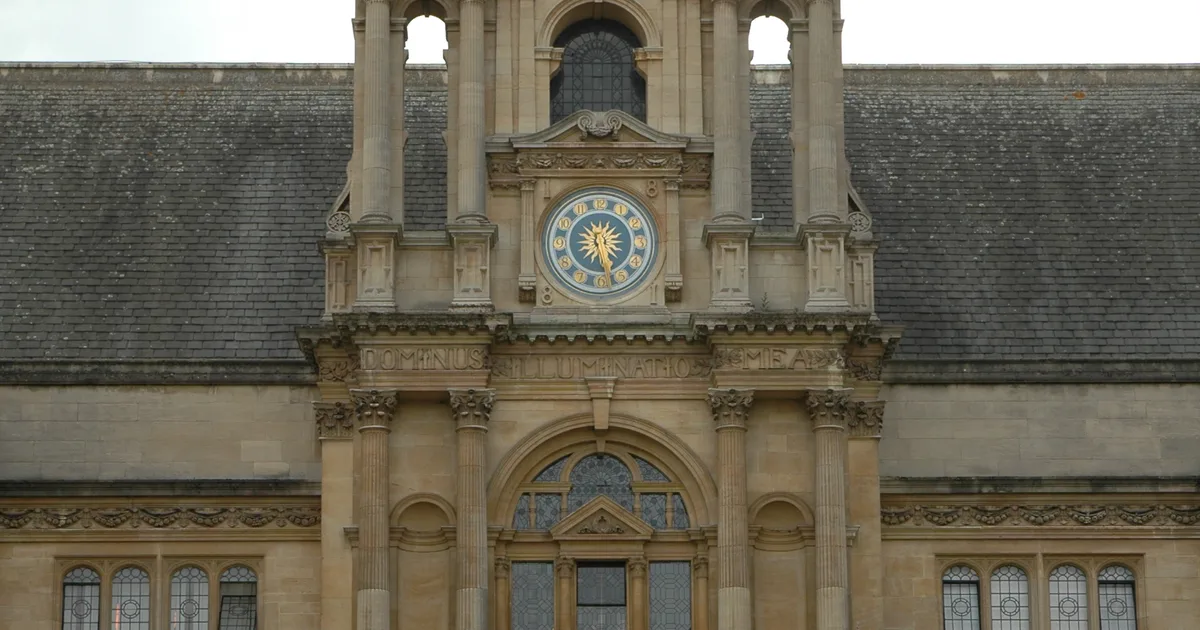
- File:Examination Schools Oxford University.jpg, Wikimedia Commons, photo by Mike Knell, 21 June 2005
- Creative Commons Attribution-ShareAlike 2.0 Generic licence