Immigration Enforcement's facial recognition policy runs 52 pages on who goes on a watchlist. None mention children, though its own cited study flags them as the technology's weakest group.
Estimated reading time: 8 minutes
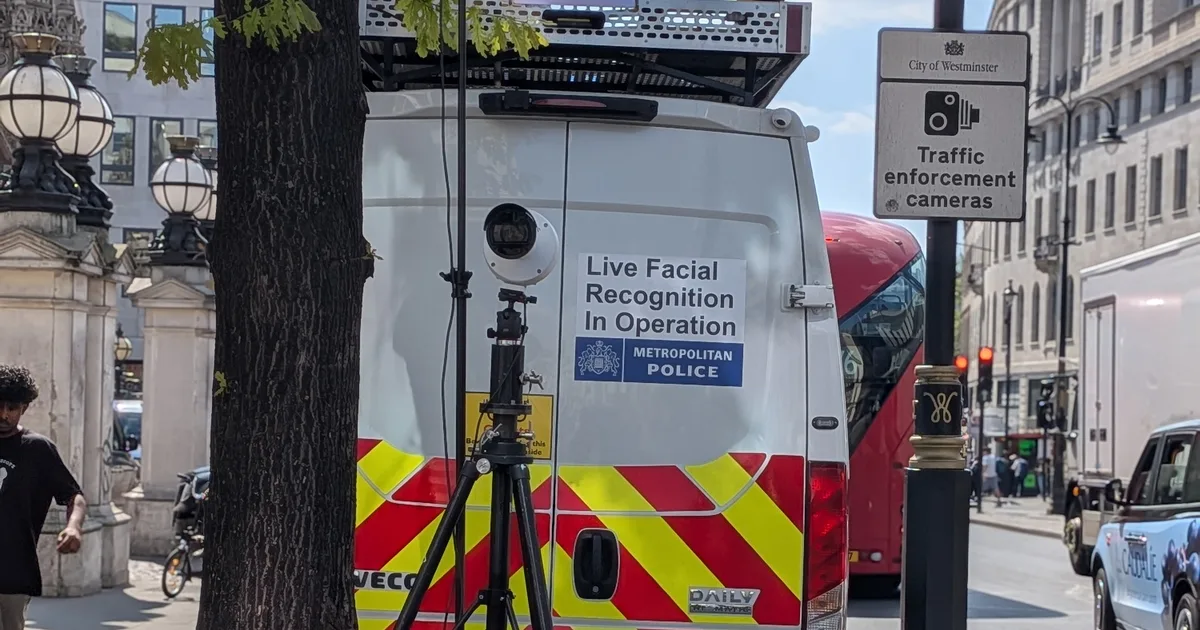

In short. Immigration Enforcement's Live Facial Recognition Policy Document, updated to version 2.3 and signed off on 28 September 2026, sets out in 52 pages who can be watchlisted, how deployments are authorised and how accurate the technology is [1]. Its accuracy case rests on a 2023 National Physical Laboratory study that was explicitly designed to test performance on people under 18, and which found the system significantly worse at recognising people under 20 than any other age group [3]. The policy quotes that finding at length. It never once uses the words child, children, minor or under 18, and its watchlist eligibility rules carry no age condition at all [1]. Two documented mistakes: four stars.
Immigration Enforcement has had a facial recognition policy since November 2025. The version now live, number 2.3, was reviewed over the summer, signed off by the programme's Senior Responsible Officer on 28 September 2026 and published to GOV.UK on 8 October 2026 [2]. It is a careful, detailed document: who can be watchlisted, who authorises a deployment, how long images are kept, how accuracy is measured. What it does not do, anywhere in 52 pages, is say what happens when the person the camera is scanning might be a child.
What the policy says
The document describes itself as "guidance for Immigration Enforcement (IE) on using overt live facial recognition to locate people of immigration law enforcement interest" [1]. Watchlist eligibility is tightly drawn on paper: "only individuals who fall within strict, objective and predefined categories may be included on an LFR watchlist", limited to people subject to a deportation order, wanted on a UK court warrant, or "actively sought for immigration enforcement or removal action, who have failed to comply with immigration conditions of entry or stay or lawful directions" [1]. None of those categories excludes a minor, and none requires an operator to check whether a watchlisted person's age is disputed.
To justify the technology's accuracy, the policy leans heavily on an outside study. "The full results are in NPL's report, Facial Recognition Technology in Law Enforcement Equitability Study," it says, describing the National Physical Laboratory as "a prestigious world leading centre of excellence" [1]. That 2023 study, NPL Report MS 43, tested the same NEC facial recognition technology police forces use during five live deployments in London and Cardiff in 2022 [3]. The policy quotes its headline numbers: a true recognition rate of 89 percent and a false alert rate as low as 1 in 60,000 at a 0.60 threshold, improving to zero false positives at the 0.64 threshold IE has chosen to use operationally [1].
It also quotes NPL's finding on age, almost verbatim. NPL recorded a true recognition rate of 83 percent for its youngest quartile, all under 20, against 90 percent or more for older subjects, a gap it called statistically significant [3]. The policy repeats NPL's own explanation for the finding: "the lower performance of the under 20s is therefore assessed to be due to both demographic and environmental factors, these being a combination of subject age and as a result subject height, and crowdedness in the zone of recognition" [1].
NPL did not test under-18s by accident. Its own report explains the choice: "the age range of the policing applications extends to those below age 18, and it is important to know whether performance is different for this demographic" [3]. The study that IE's policy leans on, in other words, was designed around the possibility that the people a watchlist camera scans could include minors. IE's own policy, written around that same study, does not carry that possibility into its eligibility rules anywhere.
The claims, tested
| The policy's own words | What the cited evidence actually shows | Verdict |
|---|---|---|
| Watchlist eligibility covers deportation orders, court warrants and non-compliance with "immigration conditions of entry or stay or lawful directions", with no reference to age [1] | Immigration Enforcement's own casework includes people whose age is in dispute: Jesuit Refugee Service UK and Humans for Rights Network recorded 174 age-disputed young people detained under the Home Office's "one in, one out" removals scheme by 24 June 2026, of whom 77 had already been identified as children by a local authority and a further 64 were later recognised as children or placed in local authority care pending inquiries [5] | The policy's own cited accuracy study was built to test performance on exactly this population. The policy's eligibility and safeguarding rules never mention it |
| "The study reported that, in its data, at a face match threshold of 0.64 or higher there were no false positive identifications. At those thresholds, FPIR was the same across race, age and gender in the study results" [1] | NPL's own report records seven false-positive identifications in total across the entire study, all at the lower 0.60 threshold, none at 0.64 [3]. Professor Pete Fussey of the University of Essex, who has advised the UK government and the UN on police facial recognition, has separately and publicly challenged conclusions drawn from this exact study: "the decisive conclusions the Met are stating publicly are based on analysis of just seven false matches. This is from a system that has analysed millions of Londoners' faces. It is a weak statistical basis to make universal claims from such a small sample" [4] | Zero false positives at 0.64 meets NPL's own definition of equitable performance. But the policy presents that result as a tested finding without flagging that it rests on an underlying sample a named independent expert has publicly queried as too small to support firm claims |
Credit where due
Large parts of this policy are genuinely careful. Watchlist entries must meet "strict, objective and predefined categories", and the document is explicit that "intelligence must not be used in isolation to create eligibility or to expand those categories" [1]. No enforcement action follows from an alert alone: "humans make all decisions about engagement or enforcement," and the biometric data of anyone who does not generate an alert "is automatically and permanently deleted" [1]. Retention for alert-related data is time-limited and specified in writing before each deployment, and the policy commits IE to "continue to monitor FRT performance, including overall accuracy and any differences in performance between demographic groups" [1], which is the right instinct even where this document falls short of it on age.
The mistakes, counted
A policy built around an accuracy study that was designed to test performance on minors never addresses minors itself (1). NPL's report states plainly that it tested under-18s because "the age range of the policing applications extends to those below age 18" [3], and found a statistically significant accuracy gap for the youngest quartile. IE's policy quotes that finding at length, then sets eligibility, safeguarding and governance rules that never mention age, children or minors, in a department that recorded 174 age-disputed detentions under one removals scheme alone in the ten months to June 2026 [5].
A zero-false-positive result is presented as a tested finding without its sample-size caveat (2). The policy states flatly that at 0.64 "FPIR was the same across race, age and gender in the study results" [1]. That is accurate as far as NPL's own equitability criteria go, but the underlying study recorded only seven false positives in total, none at 0.64, a limitation a named facial recognition researcher has publicly raised about this exact study and threshold [4]. The policy does not mention that the claim has been publicly contested, or why.
Verdict
Four stars, from two documented mistakes. This is not a reckless document. It restricts watchlist eligibility tightly, keeps humans in the decision loop, deletes non-alert data automatically and commits to ongoing accuracy monitoring, all of which is more than some facial recognition deployments elsewhere have managed. But a policy that quotes its own evidence base's finding on under-20s in detail, in a department that is currently detaining and sometimes deporting young people whose age is in dispute, cannot leave the word "child" out of 52 pages by accident. The gap is not that Immigration Enforcement is doing something unlawful. It is that a document built to show its homework has skipped the one question its own cited study went out of its way to ask.
Sources
- Immigration Enforcement Live Facial Recognition Policy Document, version 2.3, Home Office, September 2026
- Immigration Enforcement facial recognition policy, GOV.UK, last updated 8 October 2026
- Facial Recognition Technology in Law Enforcement: Equitability Study, Final Report (NPL Report MS 43), Dr Tony Mansfield, National Physical Laboratory, March 2023
- Police claims on live facial recognition bias not supported by facts: UK professor, Biometric Update, August 2025
- Children detained under 'one in, one out' scheme lays bare the UK scheme's brutal reality, Sophie Cartwright, Border Criminologies (University of Oxford Centre for Criminology), 8 July 2026