A planning right built to last three years for schools with crumbling RAAC concrete was due to run out this month. The government has just extended it to 2028, and the reason it gave the public is not the reason it gave its own consultation.
Estimated reading time: 7 minutes

In short. In October 2023, the government gave schools with crumbling RAAC concrete a time-limited right to put up temporary buildings without a planning application, due to expire on 24 October 2026. A statutory instrument made on 25 September 2026 extends that right to 24 October 2028. The Communities Secretary announced the change by saying it would mean schools "work quickly" with "minimal delays". The government's own consultation, published the same week, gives the real reason: schools are behind schedule, and the right was about to expire before the work was done. Separately, the department's "RAAC-free by 2029" pledge does not cover the 119 worst-affected schools, just over half of all 234 confirmed cases, which are only promised to be "in delivery" under a rebuilding programme funded out to 2034-35. Two documented mistakes: four stars.
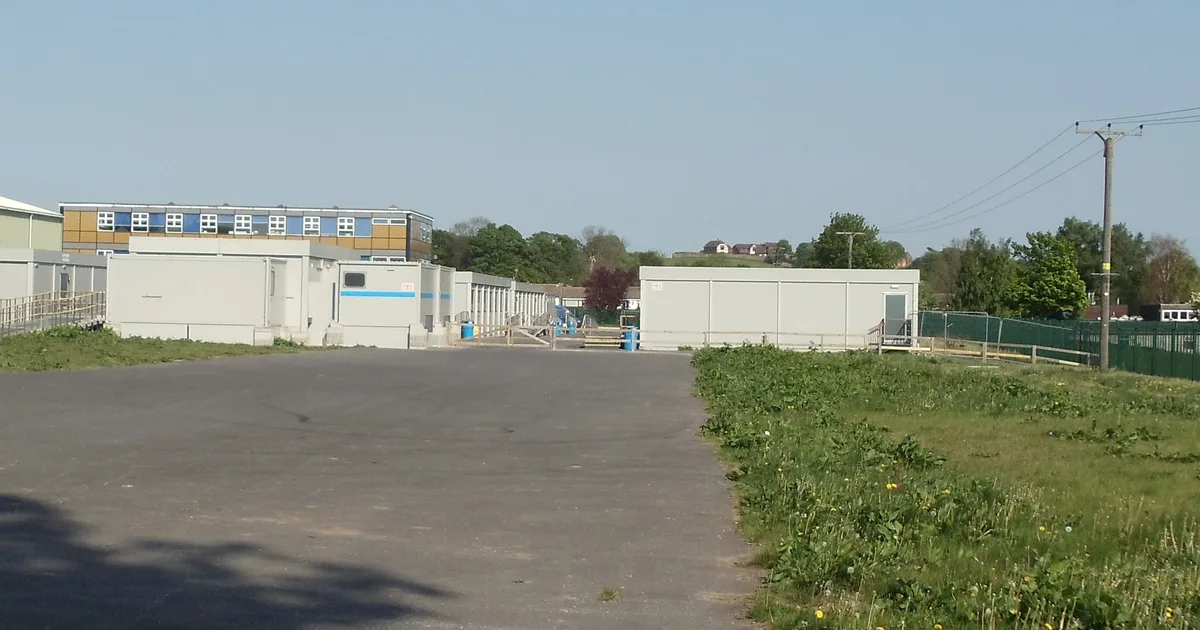
Reinforced autoclaved aerated concrete, a lightweight material used in flat roofs and floors from the 1950s to the 1990s, can fail with little warning as it ages. Its discovery in English school buildings forced more than 100 schools into hybrid or remote teaching arrangements in September 2023. Within weeks, the government created a planning shortcut: Class CB of the General Permitted Development Order let a school install temporary buildings on its own land, without submitting a planning application, so lessons could carry on somewhere safe while the RAAC-affected block was fixed or replaced [6]. The right came with real limits: no structure within 5 metres of a residential boundary, nothing over two storeys or 9 metres high, combined floor space capped at 125% of what RAAC had taken out of use, and a hard stop, the guidance said the temporary buildings "must be removed once RAAC-affected buildings on the school site have been remediated or replaced, or before the right expires on 24 October 2026, whichever comes first" [6]. Three years, then done.
Three years later, it was not done. The Town and Country Planning (General Permitted Development) (England) (Amendment) (No. 2) Order 2026, made on 25 September 2026 and in force from 21 October 2026, amends Class CB directly: "for 'three' substitute 'five', and for '2026' substitute '2028'" [1]. The order's own explanatory note confirms what that means in practice: the right "was due to expire at 11.59 p.m. on 24th October 2026", and the amendment "extends this right so that it will continue until 11.59 p.m. on 24th October 2028" [1]. A stopgap built to last three years now has a licence to run for five.
The claims, tested
| The claim | What the evidence shows | Verdict |
|---|---|---|
| Communities Secretary Steve Reed, announcing the change: "Our planning changes will mean schools can work quickly to provide RAAC-free classrooms with minimal delays" [3] | The consultation behind the same change states, in paragraph 5: "Unfortunately, not all schools will have the remediation work completed before the 24 October 2026 expiry of the permitted development right. This is due to a range of factors, principally relating to delay in the delivery of replacement permanent accommodation" [2] | The extension exists because delay has already happened, not to prevent delay. The minister's framing describes the hoped-for effect of the underlying building work; the department's own document names the actual, different reason the planning right needed extending |
| Education Estates Strategy: "By 2029, every school and college in England that is not being fully or substantially rebuilt will be RAAC-free" [4] | Of 234 education settings with confirmed RAAC, 119, just over half, are in the excluded group: schools needing "one or more buildings rebuilt or refurbished through the School Rebuilding Programme where works to remove RAAC are more extensive or complex" [5]. For that group, the 2029 commitment is only that they will be "in delivery", with half having started as of February 2026 [4], under a programme funded through to 2034-35 | "RAAC-free by 2029" is accurate only for the smaller-scale cases. For the most structurally serious RAAC schools, just over half the national total, 2029 promises construction under way, not concrete gone, on a programme with another five years to run |
The consultation is more candid than the press release that preceded it. Paragraph 4 states plainly that "the Department for Education considers that the permitted development right has been helpful in supporting over 50 schools in England" [2], a modest, rounded figure that stops well short of naming how many of the 234 confirmed RAAC settings will still need a temporary building in 2027 or 2028. No document produced for this change, not the order, not its explanatory note, not the consultation, not the announcement, gives that number. The consultation ran for eight weeks from 10 June to 5 August 2026 [2]; the government has published neither the response numbers nor a school-level account of who the extra two years are actually for.
The carve-out for School Rebuilding Programme schools is not new or hidden. In October 2025, Education Secretary Bridget Phillipson had already set out the same split: the government would "permanently remove the dangerous concrete from all schools and colleges with RAAC, except those in the School Rebuilding Programme, ahead of the next general election", while schools in that programme would "all be in delivery in the same timeframe, with more than half already underway" [7]. What changed between October 2025 and February 2026 was precision, not substance: "ahead of the next general election" became "by 2029", a specific year for a promise that, for the hardest cases, still only means building work has started. The School Rebuilding Programme itself runs to 2034-35, the same programme into which those 119 schools sit [5], so "in delivery by 2029" leaves up to five more years before the department's own timetable requires the work to finish.
Credit where due
The department has not hidden the rebuild carve-out; it has stated it in the same sentence as the 2029 pledge, twice, four months apart, in both the October 2025 announcement and the February 2026 strategy. The original Class CB conditions were genuinely tight, not open-ended: a height cap, a boundary distance, a floor-space ceiling tied to the RAAC-affected space being replaced, and a rule that playing fields and parking should be protected as far as practicable [6]. And the consultation, whatever the press release around it claims, says the true reason for the extension in plain terms, in a numbered paragraph a reader can go and check. Extending a working mechanism that schools were already using, rather than inventing something new under time pressure, is also the less risky choice.
Two documented mistakes. (1) The Communities Secretary's public explanation for extending the RAAC temporary-buildings planning right, that it would mean "minimal delays", is not the reason the government's own consultation gives; that document says the right needed extending because remediation work is already delayed. (2) The "RAAC-free by 2029" pledge in the Education Estates Strategy does not apply to the 119 schools with the most extensive RAAC problems, just over half of all 234 confirmed cases, which are only promised to be "in delivery" by 2029 under a rebuilding programme that runs five years beyond that date. Rated four stars out of five.
Sources
- The Town and Country Planning (General Permitted Development) (England) (Amendment) (No. 2) Order 2026 (legislation.gov.uk, made 25 September 2026)
- Permitted development rights: schools, assets of community value, defence and conservation (gov.uk consultation, published 10 June 2026)
- Planning changes to safeguard schools and save youth centres (MHCLG media blog, 11 June 2026)
- Education Estates Strategy: a decade of national renewal (gov.uk, updated 16 February 2026)
- Government confirms plans to permanently remove RAAC from all schools and colleges in England (gov.uk news, 8 February 2024)
- Installing temporary buildings on RAAC-affected school sites (gov.uk guidance, 31 October 2023)
- Education Secretary sets timeline for RAAC removal in schools (gov.uk news, 28 October 2025)