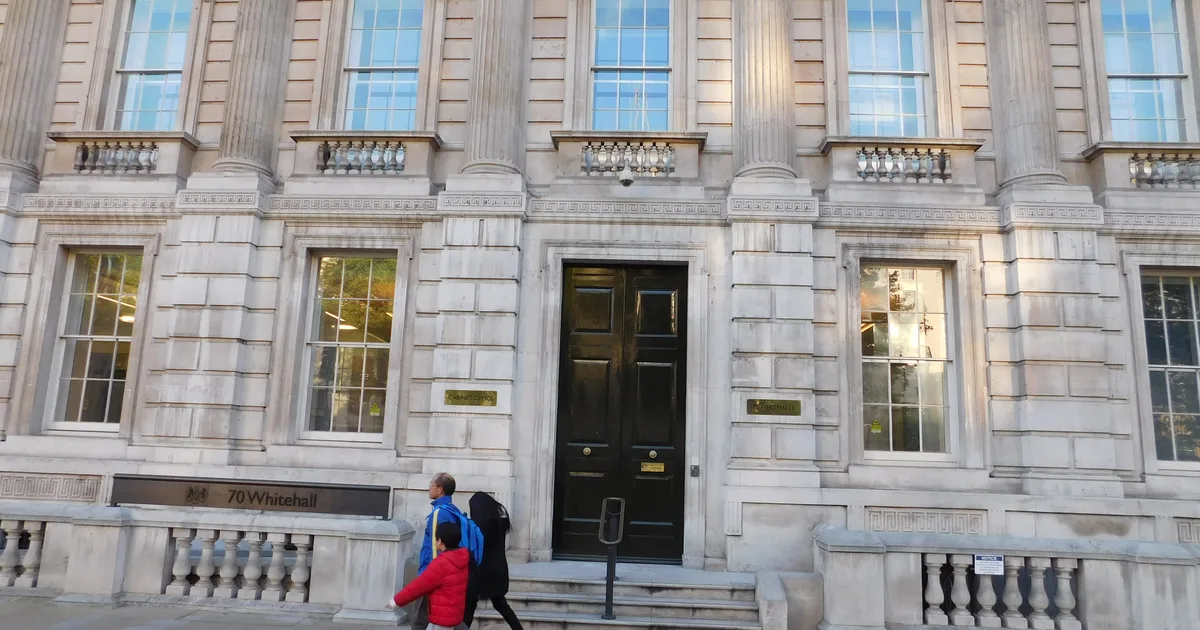
The Cabinet Office guide to hiring consultants tells civil servants to contact a Whitehall unit for help. That unit closed down in January 2023, and the guide has not been rewritten since.
Estimated reading time: 6 minutes

In short. The Consultancy Playbook tells every central government department how to hire and manage consultants, and it repeatedly directs staff to the Government Consulting Hub for triage, training and a knowledge-sharing platform. The Hub closed on 31 January 2023. The Playbook has not been revised since September 2022 and still carries an email address on the Hub's own defunct domain. The National Audit Office said in November 2025 that the document needs refreshing; the Cabinet Office says a refresh is under way. Neither has happened yet. Five documented mistakes: three stars.
Picked from the registry's queued Tier 2 entries: a live, current Cabinet Office publication with a specific, checkable claims-versus-evidence angle, and no diff or withdrawal pending. This is a Tier 2 structured teardown: claims tested against the sources they cite, mistakes counted, arithmetic shown.
The Consultancy Playbook launched in May 2021, built jointly by the Government Commercial Function and a new internal unit called the Government Consulting Hub (GCH) [1]. Version 1.1, the one still live on GOV.UK today, was published in September 2022 [1]. GOV.UK's own update log for the page records exactly one event, "Published 5 September 2022", and nothing since [2]. Four months after that publication date, the Hub the Playbook was built around stopped existing.
The claims, tested
| The Playbook's claim | What we found | Verdict |
|---|---|---|
| "Teams considering going to market for consultancy services should contact the GCH or their commercial teams to access the Triage service" [1] | Cabinet Office closed the GCH on 31 January 2023; the triage function moved to a Crown Commercial Service initiative called Prosper, named nowhere in the Playbook [4] | Fails as written |
| "We have launched the GCH Knowledge Exchange to capture and share across the Civil Service the types of tools, methodologies and thinking that we typically buy" [1] | The NAO confirms the in-house consulting service and its knowledge-sharing platform "were discontinued" when the Hub closed [4] | Fails as written |
| The companion guidance note tells staff with questions to contact "the Government Consulting Hub's Knowledge and Skills Team" at an address on the Hub's own domain [3] | That domain belonged to a unit closed since January 2023; the note itself has never been updated to remove it | Fails as written |
| The Playbook is implemented "on a comply or explain basis" [1], with departments answerable for their own consultancy spend | The central spending controls Cabinet Office ran over consultancy from 2010 to 2022 were withdrawn in 2023; departments now police their own thresholds, which the Public Accounts Committee found produces uneven scrutiny [4] | Explain to whom, exactly |
| Cabinet Office's own live Sourcing Playbook page says "the new Consultancy Playbook provides specific guidance on sourcing consultancy services" [5] | That page, last updated 15 June 2026, carries no attachment, link or cross-reference to any such document; the NAO confirms the promised refresh is still only "in the process" of happening [4] | Promised, not delivered |
The mistakes, counted
The dead triage route (1). Chapter one tells any team weighing up whether to hire a consultant to contact the GCH "at the earliest possible stage" for triage [1]. The GCH closed on 31 January 2023, as part of a civil service headcount reduction [4]. Its triage function was rebuilt at the Crown Commercial Service under a different name, Prosper. A reader following this Playbook today has no way of knowing that.
The vanished Knowledge Exchange (2). The Playbook's foreword calls the GCH Knowledge Exchange "the supporting infrastructure for new elements of the Playbook" [1], and the body text sends teams there repeatedly to check for existing toolkits and case studies before commissioning new work. The NAO's November 2025 review states plainly that when the Hub closed, "the in-house consulting services and knowledge sharing platform were discontinued" [4]. The infrastructure the Playbook is built on is gone.
The dead-domain email address (3). The companion Knowledge and Skills Guidance Note, still attached to the Playbook's live GOV.UK page, tells staff with questions to email the Hub's Knowledge and Skills Team at an address on the Hub's own domain [3]. That domain has belonged to a closed government unit for almost four years.
The unwatched comply-or-explain (4). The Playbook asks departments to apply its principles "on a comply or explain basis" [1], proportionate to the value of the work. From 2010 to 2022, Cabinet Office ran central spending controls that gave that phrase teeth. Those controls were withdrawn in 2023 to cut departments' administrative burden, and Cabinet Office now relies on departments' own internal thresholds, which the NAO found vary from department to department [4]. Comply or explain needs someone on the other end of "explain".
The uncounted spend (5). The Playbook asks contracting authorities to capture "accurate data about our use of consultancy... the suppliers used and their size, the type of consultancy, the cost and the reasons" specifically so government can "build a picture of the government's consultancy ecosystem" [1]. The NAO found the opposite: departmental definitions of consultancy spend are inconsistent enough that two commercial data platforms tracking the same government varied by an average of £270 million a year between 2017-18 and 2022-23 [4]. The picture the Playbook asks for has not been built.
Credit where due
Not every part of this document has aged badly. The distinction it draws between consultancy and contingent labour, set out in a plain comparison table on page 12, is exactly the kind of clear, practical guidance a commissioning officer can use without a training course [1]. The instruction to exhaust internal options and reuse existing knowledge before going to market is sound policy design, whatever became of the office meant to support it. The National Audit Office's own November 2025 review, drawing on interviews with departments and consultancy firms, reports that "the playbook was useful and contained sensible advice, but that it could be used more consistently" [4]. That is a fair account of a document whose ideas have outlasted the institution built to run them.
Verdict
Three stars, from five documented mistakes in a document that is, at its core, still sound guidance. None of the five are typos or dead hyperlinks of the kind that creep into any four-year-old PDF. Each is the same fault repeated in a different place: a Playbook built around a single institution, the Government Consulting Hub, that Cabinet Office closed for its own headcount reasons four months after this version was published, and never went back to fix. The Cabinet Office knows this. Its own commissioned auditor said so in public in November 2025 and reported that a refresh was "in the process" of happening [4]. Meanwhile, the Cabinet Office's own live 2026 Sourcing Playbook page tells readers a new, specific Consultancy Playbook already exists [5]. It does not, not on GOV.UK, not anywhere a civil servant following the rules would find it.
The star score counts five documented mistakes: the dead GCH triage route, the discontinued Knowledge Exchange the Playbook's own foreword calls essential infrastructure, the guidance note's email address on a defunct domain, the withdrawal of the central spending controls that gave "comply or explain" its force, and the inconsistent spend data that leaves the Playbook's own data-capture goal unmet. Five falls in the 4 to 9 band: three stars; the bands are on the ratings page. The broader question of whether government consultancy spend has actually fallen is a policy outcome, not a drafting fault in this document, and is not counted. Analysis is of the PDF edition (Version 1.1, September 2022) as served from the live GOV.UK publication page on 12 September 2026. The document is tracked in the Daily Register; a revision will get a diff entry.
Sources
- Cabinet Office, "The Consultancy Playbook", Version 1.1, September 2022 (PDF; all quoted Playbook text unless noted). https://assets.publishing.service.gov.uk/media/631f2237e90e077db807dd00/The_Consultancy_Playbook_Version_1.1_September_2022.pdf
- GOV.UK, "The Consultancy Playbook" publication page (update history: Published 5 September 2022, no entries since; checked 12 September 2026). https://www.gov.uk/government/publications/the-consultancy-playbook
- Cabinet Office, "Knowledge and Skills: Generation, Transfer and Sharing", Guidance Note, September 2022 (PDF). https://assets.publishing.service.gov.uk/media/632dc02ad3bf7f567479bd05/Knowledge_and_Skills_Guidance_Note_September_2022__1_.pdf
- National Audit Office, "Lessons learned: the government's use of external consultants" (full report PDF, 21 November 2025; summarised at the NAO's "Government's use of external consultants" insight page). https://www.nao.org.uk/wp-content/uploads/2025/11/governments-use-of-external-consultants.pdf
- GOV.UK, "The Sourcing and Consultancy Playbooks" publication page (last updated 15 June 2026). https://www.gov.uk/government/publications/the-sourcing-and-consultancy-playbooks