MPs told ministers port infrastructure deserved the same priority status as offshore wind. Ministers refused, then told the Transport Committee they had strengthened that case in a policy document that never once uses the words.
Estimated reading time: 6 minutes
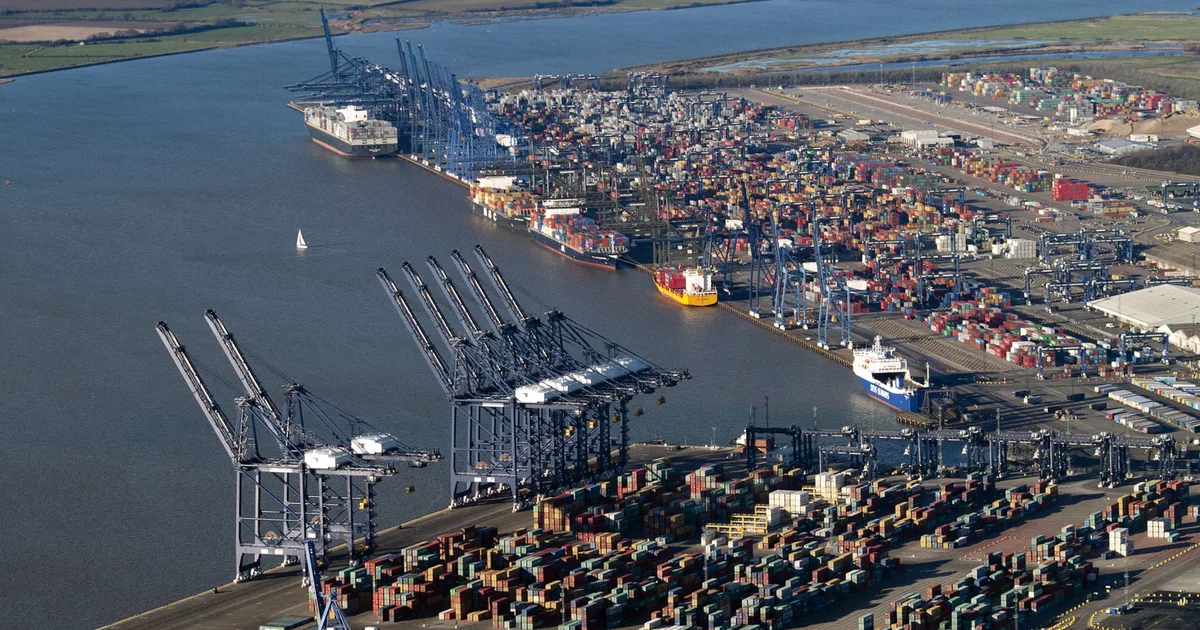

In short. The National Policy Statement for Ports (NPSP), the planning rulebook for new port development in England, replaced its 2012 predecessor with effect from 15 October 2026 [1]. The Transport Committee recommended the government grant ports Critical National Priority (CNP) status, the same planning weight given to major offshore wind and grid projects, so port upgrades needed to service that wind buildout are not left behind [3]. The government refused, then told the Committee it had "strengthened the expression of the needs case in relation to CNP infrastructure" in the final NPSP text instead [3]. The phrase "Critical National Priority" does not appear anywhere in the 103-page document that resulted [2]. Two documented mistakes: four stars.
Ports are the route for most of what Britain buys and sells. In 2024, around 85% of UK trade in goods by weight moved by sea, and ports in England and Wales alone handled 352.1 million tonnes in 2023, about 75% of UK trade by value [2], paragraphs 2.1 and 2.6, citing DfT's Port Freight Annual Statistics 2024 [4]. The Department for Business and Trade calls ports a "foundational industry" [2], paragraph 2.5. The NPSP is the document that decides how port expansion is judged under the Planning Act 2008, including the port infrastructure that offshore wind farms need to be built, operated and maintained at all [2], paragraphs 2.9 and 2.11.
A status asked for and refused
During consultation, the Transport Committee put a specific recommendation to the government: give ports the same Critical National Priority status already available to major energy infrastructure. Its reasoning, quoted in the government's own response, was that "by the Government's own admission, the ports sector is a 'foundational industry'" and should have "the primacy of port infrastructure" reinforced "in enabling energy developments" [3], paragraph 3.12. The appendix to the same response records that the House of Lords Grand Committee pressed the same point, flagging what stakeholders called a "FLOW gap": offshore wind projects get CNP-level priority under the Renewable Energy NPS, but the ports that build and maintain floating offshore wind turbines do not get the matching designation under the NPSP [3], paragraph A35.
The government's answer was direct: "the Government does not intend to accord ports Critical National Priority (CNP) status at this juncture" [3], paragraph 3.13. Its stated reasoning was that CNP energy projects will themselves generate enough demand for port capacity that ports will end up with "a degree of weighting and priority comparable with that of CNP" in practice, without the formal designation [3], paragraph 3.14. It then made a specific, checkable commitment: "We have reviewed the NPSP text with this in mind and strengthened the expression of the needs case in relation to CNP infrastructure" [3], paragraph 3.15.
| The government's claim | What the published text shows | Verdict |
|---|---|---|
| Government response to the Transport Committee, paragraph 3.15: "We have reviewed the NPSP text with this in mind and strengthened the expression of the needs case in relation to CNP infrastructure" [3] | A full-text search of the final, in-force NPSP, all 103 pages, finds no use of "Critical National Priority" or "CNP" anywhere in the document [2] | The specific wording the government says it strengthened is not in the text at all, so nobody using the published NPSP can check what "strengthened" meant |
| NPSP, paragraph 2.9: ports "should be able to invest with confidence" in facilities for offshore wind and "should not be disadvantaged" by planning delay [2] | The NPSP, unlike the Renewable Energy NPS it is meant to connect to, carries no CNP designation or equivalent named status for the port infrastructure that enables those wind farms [3], paragraph A35 | The confidence the document promises developers rests on an inferred weighting, not a defined status a developer or planning inspector can point to |
A general needs case for ports is easy to find in the NPSP: paragraph 2.33 argues there is "a strong public interest in enabling ports to service" offshore wind developments. What is absent is the specific term the government told the Committee it had used to strengthen that case. "Strengthened" is not a vague word. It describes a specific editorial change to a specific document, made in response to a specific recommendation, and reported back to the committee that asked for it. A reader checking that claim against the actual NPSP has nothing to check it against.
The capacity case leans on four old consents
The NPSP's headline policy is that applicants do not have to prove local need for a new port development. "It is Government policy that it is for each port to take its own commercial view and its own risks on its particular traffic forecasts" [2], paragraph 2.34, and "it is not government policy to dictate where port development should occur" [2], paragraph 2.38. Part of the justification is that enough capacity already exists, or soon will, without the planning system steering it.
| The document's claim | What the document itself admits two paragraphs later | Verdict |
|---|---|---|
| Four already-consented container developments, Bathside Bay (Harwich), London Gateway, Teesport and Bristol, "if all... were to be built, aggregate container capacity would be broadly in line with... demand over the next 20 years or so" [2], paragraphs 2.31-2.32 | Bathside Bay's consent dates to March 2006, and the same paragraph admits "this development is not expected to proceed for some years"; the other three consents date to 2007, 2008 and 2010 | Roughly a fifth of a century of headroom the policy leans on is contingent on sites that have sat consented but unbuilt for up to two decades |
| The capacity gap will be filled regardless of the planning system's role | "The extent, and speed, with which these developments proceed in reality will depend upon the commercial judgements of the developers at the time" [2], paragraph 2.32 | The document's own capacity case is explicitly conditional on commercial decisions it cannot predict or compel, the same uncertainty its no-need-test policy is designed to avoid asking developers to resolve |
None of this means the four sites will never be built, or that a market-led policy is the wrong choice for a sector the NPSP itself says operates "very largely without public subsidy" [2], paragraph 2.4. It means the specific capacity figures used to show the current policy will not leave the country short are drawn, in part, from consents whose own holders have had between fifteen and twenty years to build and have not.
Credit where due
The NPSP does not hide the Bathside Bay delay, it states it in the same paragraph as the capacity it is counting. The document sets out a formal review mechanism: fresh national demand forecasts "from time to time" under section 6 of the Planning Act 2008, which will supersede the current figures when published [2], paragraphs 2.29-2.30. The government's published response to the Transport Committee engages with each recommendation individually and in detail, including a specific commitment to consider forecasting methods for floating offshore wind and carbon capture traffic in the next round of demand forecasts [3], paragraph 2.4. That is a genuinely more transparent way to handle a committee's scrutiny than simply restating the original text unchanged.
Four stars, from two documented mistakes. A government that tells a select committee it strengthened specific wording in a policy document, and then publishes that document without the wording, has made a claim a reader cannot verify against its own evidence. A government that justifies not requiring new applicants to prove need, partly by counting capacity from developments consented up to two decades ago, should say plainly how much of that capacity it expects to actually arrive, not leave the uncertainty in the same two paragraphs as the reassurance.
The star score counts two documented mistakes. First, the government's formal response to the Transport Committee states it "strengthened the expression of the needs case in relation to CNP infrastructure" in the final NPSP, but the phrase "Critical National Priority" and the abbreviation "CNP" do not appear anywhere in the 103-page document that was actually published and brought into force. Second, the NPSP's case against requiring new applicants to demonstrate local need leans in part on aggregate container capacity from four port consents dated 2006 to 2010, while admitting in the same section that the oldest, Bathside Bay, "is not expected to proceed for some years" and that all four depend on "commercial judgements of the developers at the time." Two falls in the 1 to 3 band: four stars; the bands are on the ratings page. This piece makes no finding about the conduct of any named individual; the gap examined is institutional, in how the Department for Transport documented its own response to Parliamentary scrutiny and built its own capacity case, not in any single person's decision. All sources below were fetched directly on 10 November 2026.
Sources
- Department for Transport, "National policy statement for ports", gov.uk publication page (first published 6 July 2026, revised version in force from 15 October 2026, checked 10 November 2026). https://www.gov.uk/government/publications/the-national-policy-statement-for-ports
- Department for Transport, "National Policy Statement for Ports" (PDF, web version, 103pp), gov.uk (checked 10 November 2026). https://assets.publishing.service.gov.uk/media/6ae9ee37c4e9914878121f3c/national-policy-statement-for-ports-web-version.pdf
- Department for Transport, "National Policy Statement for Ports: Government response to the Transport Committee" (PDF), gov.uk (checked 10 November 2026). https://assets.publishing.service.gov.uk/media/6a463efd045e1108aaa5e997/transport-committee-consultation-response-web-version.pdf
- Department for Transport, "Port Freight Annual Statistics 2024: overview", gov.uk statistics (checked 10 November 2026). https://www.gov.uk/government/statistics/port-freight-annual-statistics-2024/port-freight-annual-statistics-2024-overview-of-port-freight-statistics-and-useful-information