The Department for Transport's first resilience strategy says 54% of England's railways will be at flood risk by mid-century. Its 22 commitments to prepare for that carry no date, budget or target.
Estimated reading time: 6 minutes

In short. The Department for Transport's first Transport Resilience Strategy, published 2 November 2026, states that "37% of railways and 38% of roads are in areas currently assessed as at risk from one or more sources of flooding", a figure it says is "expected to rise to 54% and 46% respectively" by the middle of this century [1] (page 10). The same strategy's Annex B lists 22 commitments across three objectives to address that risk and every other one it identifies; not one of the 22 carries a date, a budget or a measurable target [1] (pages 62-63). Its own implementation section confirms that is not an oversight: the department "will work with partners to translate these commitments into a clear delivery plan" only after publication [1] (page 53). Two documented mistakes: four stars.
Transport is not usually where government puts its most alarming numbers. The Department for Transport's first Transport Resilience Strategy, 66 pages, published 2 November 2026, buries one on page 10. More than a third of England's railways and roads already sit in areas the government's own flood risk modelling rates as exposed to flooding. By the middle of the century, on the same modelling, that rises to more than half the rail network. The strategy states this plainly, in its own words, sourced to the Environment Agency's own national flood risk assessment. What it does next with that number is the problem.
What the strategy's own numbers say
The relevant passage is unambiguous. "The transport system is particularly vulnerable to chronic risks. In England alone, 37% of railways and 38% of roads are in areas currently assessed as at risk from one or more sources of flooding. This is expected to rise to 54% and 46% respectively based on climate change projections by the middle of this century" [1] (page 10). The footnote attached to that sentence points to the Environment Agency's own National Assessment of Flood and Coastal Erosion Risk in England 2024, the government's authoritative model of where flooding will hit hardest. This is not a critic's estimate or an opposition press release. It is the strategy's own evidence, about the network the strategy exists to protect.
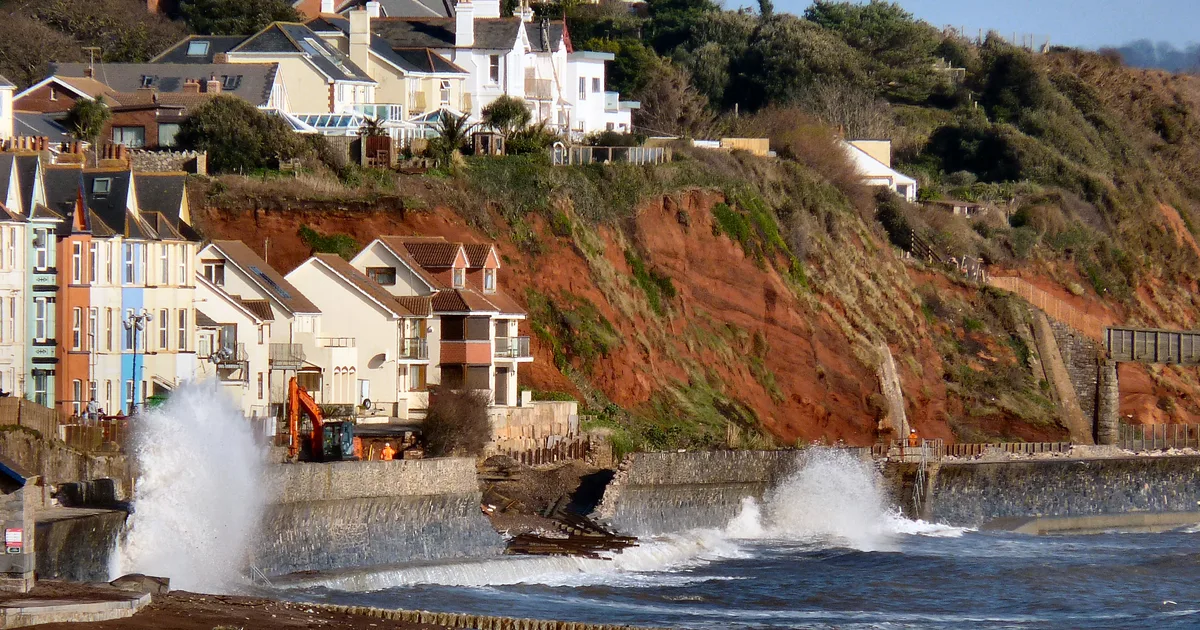
The ministerial foreword, written by Keir Mather MP, Parliamentary Under-Secretary of State for Aviation, Maritime and Decarbonisation, offers one concrete illustration of what resilience investment can look like. It recalls February 2014, when "storms caused catastrophic damage to the railway line at Dawlish, washing away sections of track and destroying the vital artery that connects communities and businesses in the south-west to the rest of Great Britain", and states that "over a decade later, a £165m package of resilience measures built by Network Rail and funded by the Department for Transport is proving to be effective at protecting the iconic stretch of track from rising sea levels and extreme weather" [1] (page 4). It is the strategy's only named success story, and it is cited twice in the opening pages. It is also a single, already-funded, site-specific scheme, decided and built in response to one storm, over the decade that followed it. The strategy names no equivalent commitment, with a budget attached, for any of the other stretches of railway or road its own page 10 figures say are now at risk.
Twenty-two commitments, zero dates
Annex B sets out the strategy's full response: 22 commitments, grouped under three objectives, each beginning with the same formula, "The Department for Transport will:" [1] (pages 62-63). Reading the full list, the verbs repeat: improve, assess, enhance, strengthen, explore, promote, develop, embed. Not one commitment in the annex carries a calendar date, a funding figure or a measurable target. The closest the strategy comes to a flagship, repeatedly-named initiative is the Transport Resilience Academy, introduced as "a new, groundbreaking" programme that will "help address" gaps in local resilience capability [1] (page 40). Its own description of what that means in practice is a pilot: "This will start as a pilot programme with a small number of local tier areas", with a wider rollout to follow "with a view to rolling out a wider offer following its successful completion" [1] (page 40). No areas are named. No date is given for the pilot to start or finish. No criteria define what "successful completion" means.
The strategy's own implementation section explains why none of this is pinned down yet, in terms that confirm the gap rather than excuse it: "This strategy has set out the key issues and transport resilience objectives for the UK over the next five to ten years. Delivery will now be taken forward through a programme of coordinated activity... The Department for Transport will work with partners to translate these commitments into a clear delivery plan, including identifying priority actions, sequencing activity, and ensuring that roles, responsibilities, and accountabilities are clearly defined" [1] (page 53). The document that was supposed to set the plan is the one that promises the plan will come later. The only accountability mechanism named is that "implementation progress will be fed into the Cabinet Office's wider Annual Statement to Parliament on risk and resilience" [1] (page 53), a reporting line, not a target.
The written ministerial statement that accompanied publication, delivered to the House of Commons the same day, does not close the gap either. It repeats the strategy's framing almost word for word, telling MPs that the strategy "makes 22 practical commitments to improve transport resilience, including the delivery of a new training initiative, the Transport Resilience Academy and the establishment of a sector-wide transport resilience network" [2]. The 37%, 38%, 54% and 46% figures that justify the strategy in the first place do not appear in the statement at all.
The claims, tested
| The strategy's own words | What its own text actually commits to | Verdict |
|---|---|---|
| "37% of railways and 38% of roads are in areas currently assessed as at risk from one or more sources of flooding", rising to "54% and 46% respectively" by mid-century [1] (page 10) | Annex B's 22 commitments, all phrased as ongoing process verbs (improve, assess, explore, develop), with no date, budget or target attached to any of them [1] (pages 62-63) | Severe, quantified, worsening risk is met with an unquantified, undated response |
| The Transport Resilience Academy is "a new, groundbreaking" programme to close local capability gaps [1] (page 40) | "This will start as a pilot programme with a small number of local tier areas," with wider rollout only "following its successful completion" [1] (page 40) | No named areas, no date, no defined success criteria for the one initiative named twice as the flagship response |
| The £165m Dawlish sea wall programme shows investment "is proving to be effective" [1] (page 4) | A single, already-funded, site-specific scheme decided over a decade in response to one 2014 storm; no second example, budget or process named for the network identified as at risk on page 10 | One proven case is not evidence of a repeatable, funded programme |
Credit where due
The strategy does not hide the number that undercuts it. The 37%, 38%, 54% and 46% figures sit in the main text, sourced and footnoted to the Environment Agency's own national risk assessment, not buried in an annex or omitted entirely. That is more candour than this site often finds. The strategy is also honest about its own status: it repeatedly describes itself as a direction-setting document for "the next five to ten years", not a funded delivery plan, and says so explicitly on page 53 rather than letting readers assume otherwise. And naming the Civil Contingencies Act categories, the National Risk Register and the Environment Agency's own flood modelling as its evidence base, rather than an unsourced internal estimate, gives a reader the means to check the claims, which is exactly what this piece has done.
Verdict
Four stars, from two documented mistakes. A government strategy is allowed to set direction before it sets a budget; that is a legitimate stage in policy development. What a strategy should not do is quote its own worst-case evidence in one section, on page 10, and then answer it, in Annex B, with 22 commitments that could just as easily have been written before that evidence existed, because none of them responds to its scale. Pairing a severe, dated, quantified risk with an unquantified, undated response is the strategy's own choice of structure, not an accident of drafting, and its own page 53 says the actual delivery plan is still to come.
The star score counts two documented mistakes. First, the strategy's own flood-risk data (page 10: 37% of railways and 38% of roads currently at risk, rising to 54% and 46% by mid-century) is followed by 22 commitments in Annex B (pages 62-63), none of which carries a date, a budget or a measurable target, including the flagship Transport Resilience Academy, described only as an unscheduled, unnamed-location pilot (page 40). Second, the ministerial foreword's only concrete evidence that resilience investment works, the £165m Dawlish sea wall programme (page 4), is a single already-funded, site-specific scheme from before this strategy existed, with no second example or process named for the rest of the at-risk network the strategy itself identifies. Two falls in the 1 to 3 band: four stars; the bands are on the ratings page. This piece makes no finding about whether the Environment Agency's underlying flood risk modelling is itself accurate, about the adequacy of the £165m Dawlish scheme on its own terms, or about funding decisions outside this strategy (such as Road Investment Strategy 3 or the highways maintenance block), none of which this piece independently tested. The source was fetched and verified live on 15 November 2026.
Sources
- Transport resilience strategy, Department for Transport, published 2 November 2026
- Building transport resilience, Keir Mather MP, Department for Transport, published 2 November 2026
- File:South Devon Railway sea wall breach February 2014.JPG, Wikimedia Commons, photo by Smalljim, 7 February 2014
- Creative Commons Attribution-ShareAlike 3.0 Unported licence